
Isaac’s genetic variation, we learned over time, was a “spectrum disorder,” and his presentation was relatively mild, with many characteristics of a typical child. While some other boys with “49” (the inner circle nickname) were not walking by age three or speaking by age five or six, our Isaac was walking at 21 months, knew all of his colors and numbers by age two, and spoke so well by age six that some speech pathologists couldn’t even identify apraxia of speech, a hallmark of the disorder. Other parents would stop us at the small family conference in subsequent years and ask if we were sure he had 49, because his development looked so typical.
We had high hopes that, despite the very real obstacles he would face in learning and development, Isaac would have a fairly “normal” life. But there was much more to come than we ever anticipated.
Glasses
We had done extra hearing and vision tests when Isaac was a baby to rule these out as possible causes of his developmental delays. At that time, there were no apparent issues, though we knew to keep an eye on any potential changes.
When Isaac was two, we set an appointment for him to see a pediatric opthalmalogist (which is no small feat in itself). If memory serves, it took several months to get in, and I still remember the stress of getting there that day. We had to drive to Texas Children’s Hospital downtown, a good 45 minute commute without traffic. We left in what should have been plenty of time, but there was a terrible accident on the Hardy Toll Road, so it took for.ev.er for us to get there. In addition to the stress of the traffic, I was worried they would cancel our appointment, as that was the policy if a patient was more than 15 minutes late.
In the end, we made it. The process was long, though I don’t remember much about it. What most stayed with me from that day was the telephone call with Todd on the way home. I told him Isaac needed glasses, and the phone went silent. A minute or so later, with a shaky voice, he said, “It just feels like another loss.”
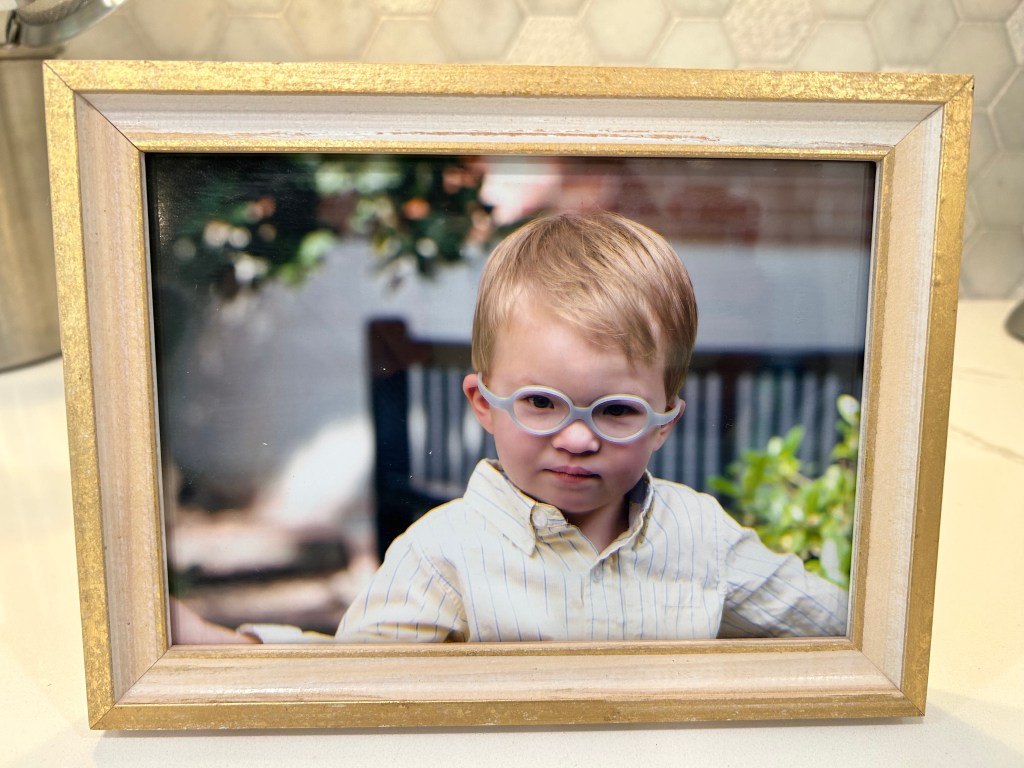
A few weeks later, after a painstaking search for an optometrist who could fit Isaac properly for glasses, we drove out to Katy to pick them up. He was so stinking cute in his gray Miraflex glasses, we could hardly be sad on that day. The optometrist even asked us to come back for a photo shoot so their office could feature Isaac in their upcoming ad campaign. (The featured image for this post is the shot they used in the newspaper.)
Therapies
I guess I expected the therapies we began with ECI would be temporary, but they were not. When Isaac turned three (the conclusion of ECI services), we started the PALS program through our local school district, where Isaac attended classes for kids with language learning delays two days per week. We also started private speech, occupational, and physical therapy at a wonderful place called Aspire. For a long stretch of time, Isaac had six private therapies each week.
While other kids were starting T-ball, soccer, and the like, we spent our time in therapy sessions and waiting rooms. I remember being pregnant with Gillian in those rooms, her crawling on the floors, learning from the very beginning that much of our life would revolve around her brother.
I also remember the moms. Not just the ones who were there for a single speech session, but the ones who were there because their kids faced multiple challenges. The one whose son was a little person, a boy who became one of Isaac’s first friends. The one who was always there when I was (for multiple sessions in a row) whose child had a cochlear implant. The one with an older, bigger son, who couldn’t be still, who stomped around the waiting room, constantly in motion. We all wore our hearts on our sleeves, because we couldn’t hide how hard it was. One of the regular moms had three kids, and I’ll never forget her saying, “At the end of the day, if they’re in bed and they’ve been fed and they’re not dead, it was a good day.” Amen.
School
Isaac started a Mother’s Day Out program at our church when he was two, going two days a week for five hours. He had an August birthday, and we decided to start him in a younger class. We told the head of school about his diagnosis but otherwise spoke only of delayed development. I stayed in touch with his teachers about how he was doing and what additional attention he seemed to need, because they observed him with other children more than I ever had up to that point. For the most part, I was encouraged.
In his second year there, I believe, one of the teachers mentioned to me that he seemed to enjoy the company of one of the other students. I don’t remember his name–Hunter, maybe. I met his mother, and we set up a play time outside of school at their home. There was a moment during the playdate where Isaac did something unexpected, an unusual reaction to something her son said or did, though I don’t remember specifics. I decided then to tell the mom about Isaac’s diagnosis to help give some context. After that day, she never responded to a single call or text.
Maybe you’re thinking, along with me, “shame on her.” I was understandably hurt and upset. At the same time, I’ve often reflected back and wondered if she had some fears about her own child’s development, and knowing that the child he connected with at school was neurodivergent may have scared the hell out of her. I try to have compassion. I haven’t thought about this story in a long time, but it still gets me. I do remember her name, and I hope all of the hell got out.
Dr. Sprouse, the neurodevelopmentalist who specializes in XY chromosome variations, told us early on that the best school for Isaac would be one for kids with language-based learning differences. Todd found The Parish School in the Spring Branch neighborhood of Houston, and one day when I was in the area, I drove by. It looked peaceful, serene, inviting. Our first in-person visit with Isaac was exceptional. Initially we had been terrified to think that Isaac would need specialized schooling. But once we visited The Parish School and had Isaac go through their evaluation process, we were thrilled that he qualified for the program.
Grief
These few episodes in Isaac’s early years are just a snapshot of our experience as his parents. It felt like there was something unexpected around every corner. The grief of having a child with disabilities is not a single event but something that unfolds continually over time. It is different from death, but these words from Donna Ashworth resonate nonetheless: “You don’t just lose someone once / You lose them over and over, / sometimes many times a day. / When the loss, momentarily forgotten, creeps up, / and attacks you from behind. / Fresh waves of grief as the realization hits home, / they are gone. / Again.” (https://donnaashworth.com/you-dont-just-lose-someone-once/)
And I suppose what was really gone, over and again, was my expectation of normal, of what our life would be.
There was no way of knowing it at the time, but that loss of “normal” would increase exponentially when Isaac was four, with an onslaught of seemingly unrelated symptoms and behavioral problems that turned our already shaken world upside down. It was the onset of PANS, though we wouldn’t know it for seven more years. And although Isaac’s backstory is long and complex, PANS can impact *anyone.* It is a little-known disorder, even among doctors, and anyone who has lived with it can tell you, we need to make it known. PANS is a devastating syndrome, but it is curable when it’s recognized early and treated properly. This is what compels me to tell our story. Please stay tuned.
 Gray Colored Glasses
2 responses to “Glasses and grief”
Ann, thanks for taking the time (and having the energy) to share your family’s story. It is not just Isaac’s story, but your entire family. We all need the education.
LikeLiked by 1 person
Thank you for your kind words. That is my hope, that it will help not only families in challenging circumstances, but anyone who takes the time to read our story. I appreciate your comment so much.
LikeLike