
If you’ve followed Gray Colored Glasses for any length of time, you know the backdrop to Isaac’s onset of PANS, Pediatric Acute-onset Neuropsychiatric Syndrome, at age four. (To catch up, see Our story & my WHY.)
This post marks the beginning of a next chapter, and not an easier one. It began with a serious illness, which we would later identify as the beginning of Isaac’s battle with PANS, though at this point in time, we had no idea. (It would be over seven years before we got a proper diagnosis in February 2020.)
It’s one thing to read PANS Diagnostic Criteria and something else to experience this disorder in real time. Part of raising awareness around PANS/PANDAS, for me, is helping people to understand what it can “look like” and feel like when it’s happening in your child or someone you know.
Keep in mind, as you read this story, PANS/PANDAS is a post-infectious disorder, which means symptoms begin following a viral or bacterial infection. PANS/PANDAS is a mis-directed response of the immune system, which attacks the brain instead of the infection, leading to psychiatric symptoms. In our case, Isaac appeared to recover completely from his illness, with symptoms presenting several weeks later.
The Big Sick
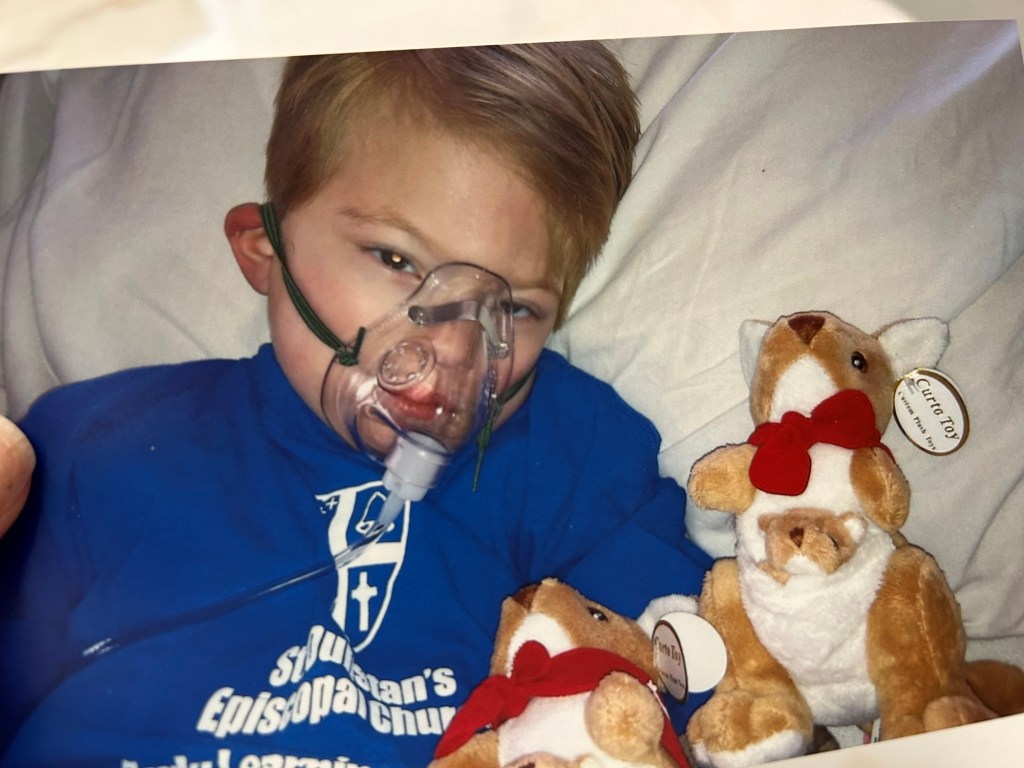
In October of 2012, when Isaac was four, he became seriously ill with the flu. We had already taken him to the doctor, and we’d been giving him Tamiflu for several days. He seemed to be stable, maybe even improving, until the fourth or fifth day after our visit. His breathing was labored, his fever increased. We decided to take him to the ER, where his temperature registered 105. He was transferred to Texas Children’s Hospital downtown, where he spent the first couple of days in pediatric ICU.
In the end, Isaac would spend seven days and nights in the hospital, with the flu, pneumonia, RSV, and labored, asthmatic breathing. For part of that time, he was on a bi-pap machine and also required the “shake vest” to loosen pockets of pneumonia in his lungs. I was never really afraid that he wouldn’t get better, but only because I couldn’t let my mind go there.
By my standards, Isaac was sick a lot as a child, with chronic ear infections, upper respiratory infections, and cough-variant asthma. But this seven-day hospital stay was “the big sick,” the scary one, that in hindsight marked a major turning point in his development.
Isaac wasn’t easy before this hospitalization, so we didn’t recognize immediately that anything was different or worse afterward. But we were also in mourning. My beloved dad had died from ALS two weeks before Isaac got the flu. And the day we took Isaac to the ER was our baby girl’s first birthday. Everything was big at that moment in time. We were already in survival mode as a family. And in the weeks and months that followed, Isaac went from challenging to truly impossible.
Onset of PANS
Every day, often multiple times a day, Isaac had raging meltdowns that I could only describe as “primal.” When he was upset, which was inexplicably often, it was so arresting that everything else in our home stopped. It had to. He would scream, throw his glasses (or his toys if he was holding any), and go into a full-body thrash. Anybody standing nearby was going to get hit, or kicked, and not because he was an aggressive child, but because he could not contain himself. You could look at him and tell he did not have control over his body.
Sometimes there was an apparent trigger, but just as often there was NONE. No antecedent to explain the response that followed. These rages would last for hours at a time, multiple times a day. It was completely and entirely debilitating.
I knew four year olds had fits. But these didn’t look like the fits I’d seen other children have. We tried to tell Isaac’s doctors how bad it was. And maybe, at the same time, we tried to take the edge off, just a little. Because when your child acts like THIS, you don’t really want anyone to know.
We also assumed—as did our doctors—that the way Isaac was acting was tied to his genetic disorder. It was a ready explanation and scapegoat: an extremely rare chromosome variation associated with atypical childhood development. Maybe, we all reasoned, this is what you get when you have a child with 49,XXXXY who is also intelligent, aware of his differences, and frustrated at every turn. Because he can’t make his body do what he wants it to do (fine and gross motor challenges). Or because, in moments of crisis, he doesn’t understand, or can’t find the words to tell us, what is happening.
This was the best explanation we could find and the one we lived with for seven+ years.
Relapsing and remitting
Yes, there were seasons of reprieve, where Isaac seemed to be doing better and we thought he’d grown out of this terrible phase or developed skills he previously lacked to handle frustration. But then something would change—we never understood what—and we would be right back where we started: Isaac raging uncontrollably, breaking his glasses, the television, our hearts. It was brutal.
What we understand now is that every time Isaac became sick and we treated him for his illness—an upper respiratory infection more often than not—he appeared to make a full recovery, but about two to three weeks later, the same familiar symptoms would return. Not coughing or congestion, mind you, but screaming, raging, breaking things, literally terrorizing our home. And each new round would last for months, even years, before symptoms finally seemed to subside.
This is what we now know is the “relapsing and remitting” course of PANS, when acute symptoms become a chronic disorder. But despite all of our seeking, we didn’t know how to connect the dots between these “behaviors” and the illnesses that preceded them, and neither did our doctors. This is why I’m on a mission to make sure other families—and their doctors—do.
Additional symptoms
At home, Isaac’s rage was the symptom that eclipsed all others. But there were others, and there were problems at school, too. I remember when our functional medicine doctor first told me she thought Isaac had PANS, and I looked it up online. I read through the diagnostic criteria: “Abrupt, acute onset of Obsessive Compulsive Disorder or severely restricted food intake” and “similarly acute onset and severity from at least 2 of the following categories …,” and it felt like a punch in the gut.
Anxiety; Emotional Lability and/or Depression; Irritability, Aggression, and/or Severe Oppositional Behaviors; Behavioral (Developmental) Regression; Sudden Deterioration in School Performance; Motor or Sensory Abnormalities; Somatic Signs and Symptoms, including Sleep Disturbances, Enuresis, or Urinary Frequency.
Isaac had them all. Every. Single. One.
But that’s a subject for another post.
 Gray Colored Glasses
2 responses to “The Big Sick”
I remember the Big Sick! Scary days. Great article and I’m so happy for Isaac AND the fam. He’s such a kind young man.
LikeLike
You and Tiffany have had front row seats to the entire roller coaster of Isaac’s childhood. We love you all and don’t know how we could have survived without your friendship.
LikeLike